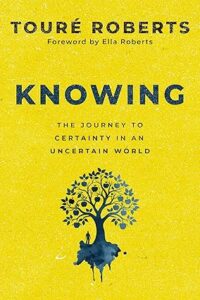
Knowing: The Journey to Certainty in an Uncertain World – Honest & In-Depth Review
Introduction
In a time when uncertainty dominates daily life—whether in career decisions, relationships, or personal identity—books that promise clarity often attract strong attention. Knowing: The Journey to Certainty in an Uncertain World by Touré Roberts positions itself as a guide for navigating this uncertainty with confidence and inner peace.
Published in 2026 by Zondervan, this 224-page work blends spiritual insight, personal development, and practical reflection. It aims to help readers develop what the author calls “Knowing”—a deep internal awareness that acts as a compass in life’s most confusing moments.
This review explores the book’s core ideas, writing style, strengths, and limitations—offering a balanced perspective for potential readers.
Core Concept: What Does “Knowing” Mean?
At the heart of the book lies a central idea: certainty doesn’t come from controlling external circumstances, but from cultivating inner clarity.
Roberts introduces “Knowing” as a state of awareness and trust in one’s inner voice, allowing individuals to make decisions even when the path ahead is unclear.
Instead of promising predictable outcomes, the book shifts the focus inward. It encourages readers to:
- Trust their intuition
- Overcome fear and second-guessing
- Develop emotional and spiritual clarity
This concept is particularly relevant in modern life, where information overload often leads to confusion rather than confidence.
Structure and Content Overview
The book is structured around a mix of:
- Personal stories from the author
- Reflective insights
- Practical exercises
Rather than being purely theoretical, it attempts to guide readers step-by-step toward developing this inner clarity.
Key themes include:
- Breaking free from confusion and anxiety
- Understanding how trauma and stress affect decision-making
- Rebuilding trust in oneself
- Making confident life choices
The author emphasizes that uncertainty is unavoidable—but clarity within it is achievable.
Writing Style and Readability
One of the most noticeable aspects of this book is its accessible and conversational tone.
Roberts writes in a way that feels direct and personal, often speaking as if addressing the reader individually. This makes the book:
- Easy to read
- Emotionally engaging
- Suitable for a wide audience
The language avoids overly academic or complex terminology, which broadens its appeal beyond strictly religious readers.
However, the tone leans heavily toward motivational and reflective writing rather than analytical depth. This is important to consider depending on your reading preferences.
Practical Value and Real-Life Application
A major strength of this book is its focus on practical transformation rather than abstract ideas.
Readers are encouraged to actively engage with the material through:
- Self-reflection exercises
- Mindset shifts
- Intentional decision-making practices
The advice centers on developing clarity in everyday situations, such as:
- Career decisions
- Personal relationships
- Financial choices
The book argues that once inner clarity is established, external decisions become more aligned and less stressful.
This makes it particularly useful for readers who feel stuck, overwhelmed, or uncertain about their direction in life.
Strengths of the Book
1. Clear and Focused Message
The concept of “Knowing” is consistent throughout the book, giving it a strong sense of direction.
2. Highly Relatable Themes
Topics like anxiety, doubt, and decision-making resonate with a broad audience.
3. Action-Oriented Approach
The inclusion of exercises and practical insights makes the book more than just inspirational—it becomes a tool for change.
4. Emotional Connection
Personal stories help create a deeper connection between the author and the reader.
5. Modern Relevance
The focus on navigating uncertainty reflects real-world challenges faced today.
Potential Drawbacks
1. Repetitive Ideas
At times, the central concept of “Knowing” is repeated in similar ways, which may feel redundant for some readers.
2. Limited Depth for Analytical Readers
Those looking for research-heavy or scientific explanations may find the content too anecdotal.
3. Strong Spiritual Perspective
While accessible, the book is rooted in a spiritual worldview, which may not appeal equally to all audiences.
Who Should Read This Book?
This book is best suited for:
- Readers interested in personal growth and self-discovery
- Individuals facing uncertainty or major life decisions
- Those who appreciate spiritually inspired guidance
- Beginners in self-help or motivational literature
It may be less suitable for readers seeking purely psychological or evidence-based frameworks.
Comparison to Similar Books
Compared to other personal development books, Knowing stands out for its emphasis on inner awareness rather than external productivity systems.
While many self-help books focus on habits, goals, or time management, this one focuses on internal alignment and clarity.
This makes it more reflective and introspective, rather than performance-driven.
Overall Value
Considering its content, structure, and approach, Knowing: The Journey to Certainty in an Uncertain World offers strong value for readers seeking clarity and direction.
It doesn’t attempt to provide all the answers—instead, it helps readers develop the confidence to find their own.
For its target audience, this approach can be both empowering and practical.
Final Verdict
Knowing: The Journey to Certainty in an Uncertain World is a thoughtful and accessible guide for navigating life’s uncertainties with greater confidence.
Its strength lies in its simplicity and emotional resonance, making it easy to apply in real-life situations. While it may not satisfy readers looking for deep analytical frameworks, it succeeds in delivering a clear and meaningful message about inner clarity.