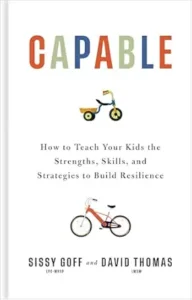
In-Depth Review: Capable: How to Teach Your Kids the Strengths, Skills, and Strategies to Build Resilience
Introduction
Capable: How to Teach Your Kids the Strengths, Skills, and Strategies to Build Resilience is a modern parenting guide written by therapists Sissy Goff and David Thomas, designed to address one of the most urgent challenges families face today: raising emotionally strong, resilient children in an increasingly anxious world.
Rather than offering generic parenting advice, this book focuses on a central idea—capability—the belief that children can face challenges, adapt, and grow stronger through adversity. Built on decades of counseling experience, the book blends psychological insight with practical strategies, making it both thoughtful and actionable.
This review provides a detailed, original evaluation of the book’s content, structure, strengths, and limitations—aligned with Amazon Affiliate guidelines.
Book Overview
Published in 2026 by Bethany House, the book spans roughly 296 pages and falls within the parenting and personal development genre.
The authors draw from over 50 years of combined counseling experience, offering a clinically grounded yet accessible approach to raising confident children.
At its core, the book argues that today’s children face unprecedented levels of anxiety and emotional pressure, and traditional parenting methods may no longer be sufficient.
Instead of focusing solely on happiness or protection, the authors emphasize building internal strength and adaptability.
Writing Style & Structure
The writing style is clear, conversational, and empathetic, making complex psychological concepts easy to understand. The authors avoid academic jargon and instead use:
- Real-life parenting scenarios
- Simple frameworks and strategies
- Practical examples that feel relatable
The book is structured in a way that gradually builds understanding:
- Identifying the problem (modern childhood anxiety)
- Introducing the concept of “capability”
- Providing actionable tools and strategies
Each chapter feels purposeful and focused, often ending with practical takeaways that parents can apply immediately.
Core Concept: Raising “Capable” Kids
The central idea of the book is simple but powerful:
Capable kids believe they can handle hard things.
According to the authors, capable children:
- Do not avoid challenges
- Recover from setbacks
- Develop confidence through experience
This mindset is not innate—it must be taught, modeled, and reinforced through parenting.
The book reframes parenting from:
- Protecting children from difficulty
➡️ to - Preparing them to handle difficulty
This shift is one of the book’s most valuable contributions.
Key Themes Explored
1. Resilience Over Comfort
The book challenges the modern tendency to prioritize comfort and immediate happiness. Instead, it encourages parents to allow children to experience manageable levels of struggle.
This aligns with psychological research suggesting that resilience develops through supported challenges, not avoidance.
2. Emotional Regulation
A major focus is helping children understand and manage their emotions. The authors emphasize:
- Naming emotions
- Processing feelings
- Developing healthy coping strategies
Rather than suppressing emotions, the goal is to build awareness and control.
3. Risk-Taking & Growth
The book encourages parents to let children take appropriate risks—social, academic, and personal.
This includes:
- Trying new activities
- Facing failure
- Learning from mistakes
These experiences are framed as essential for building confidence and independence.
4. Parental Role Transformation
Parents are guided to shift from:
- Problem-solvers
➡️ to - Coaches and guides
Instead of fixing every issue, the book promotes asking questions, encouraging independence, and allowing children to think through problems.
Practical Strategies & Tools
One of the strongest aspects of the book is its actionable advice. It doesn’t just explain concepts—it provides methods to apply them.
Examples include:
- Encouraging problem-solving instead of giving answers
- Setting boundaries that promote responsibility
- Modeling calm responses to stress
- Creating environments where failure is safe
These strategies are realistic and adaptable to different parenting styles.
Strengths of the Book
1. Evidence-Based Approach
The authors combine clinical experience with research-backed insights, making the advice credible and relevant.
2. Highly Practical
Unlike many parenting books that remain theoretical, this one offers clear, usable strategies that parents can implement immediately.
3. Modern Relevance
The book directly addresses current issues such as:
- Anxiety in children
- Overprotection
- Social and academic pressure
This makes it particularly relevant for today’s parents.
4. Balanced Perspective
The book does not advocate harsh parenting or “tough love.” Instead, it promotes a balance between:
- Support
- Challenge
This balanced approach makes the guidance feel realistic and sustainable.
Potential Drawbacks
1. Repetition of Core Idea
The concept of “capability” is central to every chapter, which can feel repetitive at times.
However, this repetition also reinforces the main message.
2. Faith-Based Elements
Some sections include a faith-informed perspective, which may resonate strongly with some readers but feel less relevant to others.
3. Not a Quick Fix
This book is not about instant solutions. It requires:
- Consistency
- Patience
- Long-term commitment
Parents looking for quick behavioral fixes may find it less immediately satisfying.
Who Should Read This Book?
This book is ideal for:
- Parents of children and teenagers
- Caregivers dealing with anxiety-related challenges
- Educators and counselors
It is especially useful for those who want to raise independent, emotionally strong children rather than simply well-behaved ones.
Comparison to Similar Parenting Books
Compared to traditional parenting guides, Capable stands out for its focus on internal resilience rather than external behavior control.
It shares similarities with modern parenting philosophies that emphasize:
- Growth mindset
- Emotional intelligence
- Long-term development
However, its structured and practical approach makes it more actionable than many competitors.
Final Verdict
Capable: How to Teach Your Kids the Strengths, Skills, and Strategies to Build Resilience is a thoughtful, practical, and timely parenting guide that addresses one of the most critical challenges of modern childhood.