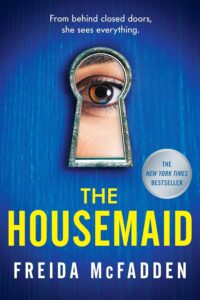
A Deep Dive Review of The Housemaid
Psychological thrillers thrive on tension, secrets, and the unsettling realization that nothing is quite what it seems. The Housemaid by Freida McFadden fully embraces these elements, delivering a tightly constructed narrative that steadily draws readers into a web of manipulation, deception, and moral ambiguity. It’s a novel that doesn’t rely on elaborate settings or overly complex subplots; instead, it builds its impact through atmosphere, character dynamics, and carefully controlled revelations.
A Premise Built on Unease
From the opening chapters, the story establishes a sense of quiet discomfort. The protagonist, working as a housemaid for the seemingly affluent Winchester family, occupies a position that is both intimate and isolating. She is inside the home, observing everything, yet remains fundamentally disconnected from the life she helps maintain.
This contrast creates a strong narrative tension. The house itself becomes more than just a setting—it functions as a controlled environment where appearances are carefully managed, and underlying truths remain hidden.
As the protagonist navigates her daily responsibilities, small irregularities begin to surface. These moments are subtle at first, but they accumulate, creating an atmosphere where even ordinary interactions feel charged with meaning.
Character Dynamics That Drive the Story
The strength of The Housemaid lies in its characters and the relationships between them. Each member of the household contributes to the unfolding tension in distinct ways.
The Protagonist
She is observant, resourceful, and shaped by a past that is gradually revealed. Her perspective anchors the story, guiding readers through shifting perceptions of trust and suspicion.
Nina Winchester
Nina’s behavior introduces unpredictability into the narrative. Her actions often seem contradictory, blurring the line between instability and intention. This ambiguity keeps readers questioning her role throughout the story.
Andrew Winchester
Andrew appears reserved and emotionally burdened, adding another layer of complexity. His interactions with the protagonist suggest depth, but also raise questions about what remains unspoken.
The interplay between these characters creates a dynamic where alliances feel uncertain and motivations are constantly in flux.
The Power of Perspective
One of the most effective techniques used by Freida McFadden is the control of information. The story unfolds through a limited perspective, meaning readers only know what the protagonist knows—or believes she knows.
This approach has several effects:
- It heightens suspense by withholding key details
- It allows for shifts in perception as new information emerges
- It encourages readers to actively interpret events rather than passively consume them
As the narrative progresses, earlier assumptions are challenged, leading to moments of realization that redefine the story.
Pacing and Structure
The pacing of The Housemaid is carefully calibrated. Early chapters focus on establishing routine and environment, creating a baseline of normalcy. As the story develops, this normalcy begins to fracture.
Midway through the book, the tension intensifies significantly. Events unfold more rapidly, and the stakes become clearer. The narrative momentum builds toward a climax that relies on both psychological and situational elements.
The structure supports this progression:
- Beginning: Establishment of setting and characters
- Middle: Escalation of tension and introduction of key conflicts
- End: Resolution through revelation and consequence
This steady escalation keeps readers engaged without overwhelming them.
Themes Beneath the Surface
While the novel functions effectively as a thriller, it also explores several underlying themes:
1. Power and Control
The household dynamic reflects broader questions about who holds power and how it is exercised. Control is not always obvious; it can be subtle, psychological, and deeply embedded in everyday interactions.
2. Identity and Reinvention
The protagonist’s past plays a crucial role in the story, highlighting how identity can be shaped, concealed, or transformed. The idea that people are not always who they appear to be is central to the narrative.
3. Perception vs. Reality
Much of the tension arises from the gap between what is seen and what is true. The novel repeatedly challenges assumptions, reminding readers that appearances can be misleading.
4. Isolation
Despite being surrounded by others, the protagonist experiences a strong sense of isolation. This emotional distance amplifies the psychological tension and contributes to the story’s atmosphere.
Writing Style and Tone
Freida McFadden employs a direct and accessible writing style that prioritizes clarity and momentum. The prose is not overly descriptive, but it is effective in conveying mood and emotion.
The tone remains consistently tense, with moments of unease woven into even the simplest scenes. This consistency helps maintain suspense throughout the book.
Dialogue plays an important role as well, often revealing more through subtext than through explicit statements.
Accessibility and Reader Experience
One of the notable aspects of The Housemaid is its accessibility. The story is easy to follow, making it suitable for a wide range of readers.
At the same time, it offers enough complexity to remain engaging for those familiar with the genre. The balance between simplicity and depth allows the book to appeal to both casual readers and dedicated thriller fans.
Considerations for Potential Readers
While the book is engaging, there are a few points to keep in mind:
- The story includes psychological tension that may feel intense for some readers
- Themes of manipulation and control are central to the narrative
- The focus on a confined setting may not appeal to those seeking broader world-building
These elements are integral to the story’s design and contribute to its overall impact.
Who This Book Is For
The Housemaid is particularly well-suited for:
- Fans of psychological thrillers
- Readers who enjoy character-driven suspense
- Those interested in stories with twists and shifting perspectives
- Anyone looking for a fast-paced and engaging narrative
It may be less suitable for readers who prefer lighter or more straightforward stories.
Final Thoughts
The Housemaid delivers a compelling and immersive reading experience by focusing on atmosphere, character dynamics, and controlled storytelling. Freida McFadden demonstrates a strong understanding of suspense, using subtle cues and strategic reveals to keep readers invested.